








.webp)
Online therapy that works – proven, accessible and free.

Support for tāngata whai ora
Give the people you support free, immediate access to evidence-based mental health courses, including Cognitive Behavioural Therapy (CBT) and other proven interventions to strengthen their wellbeing.
4,773
Healthcare workers have signed up to support tāngata whai ora with Just a Thought courses.

19 free online courses
For common challenges like anxiety, low mood and insomnia to more complex condititions like OCD, panic and addicition.

Over 92,000 total course enrolments since launching in 2019.
Backed by more than
120 randomised, controlled trials and academic studies.
Many of the Just a Thought courses were initially developed by a team of clinicians and researchers from St Vincent's Hospital, Sydney and the University of New South Wales to improve personal wellbeing and for the treatment of anxiety and depressive disorders. All courses have been redesigned and enhanced by Just a Thought, with guidance from clinicians, cultural advisors, and Lived Experience experts, for the New Zealand environment and people.
How it works...

Sign up and prescribe
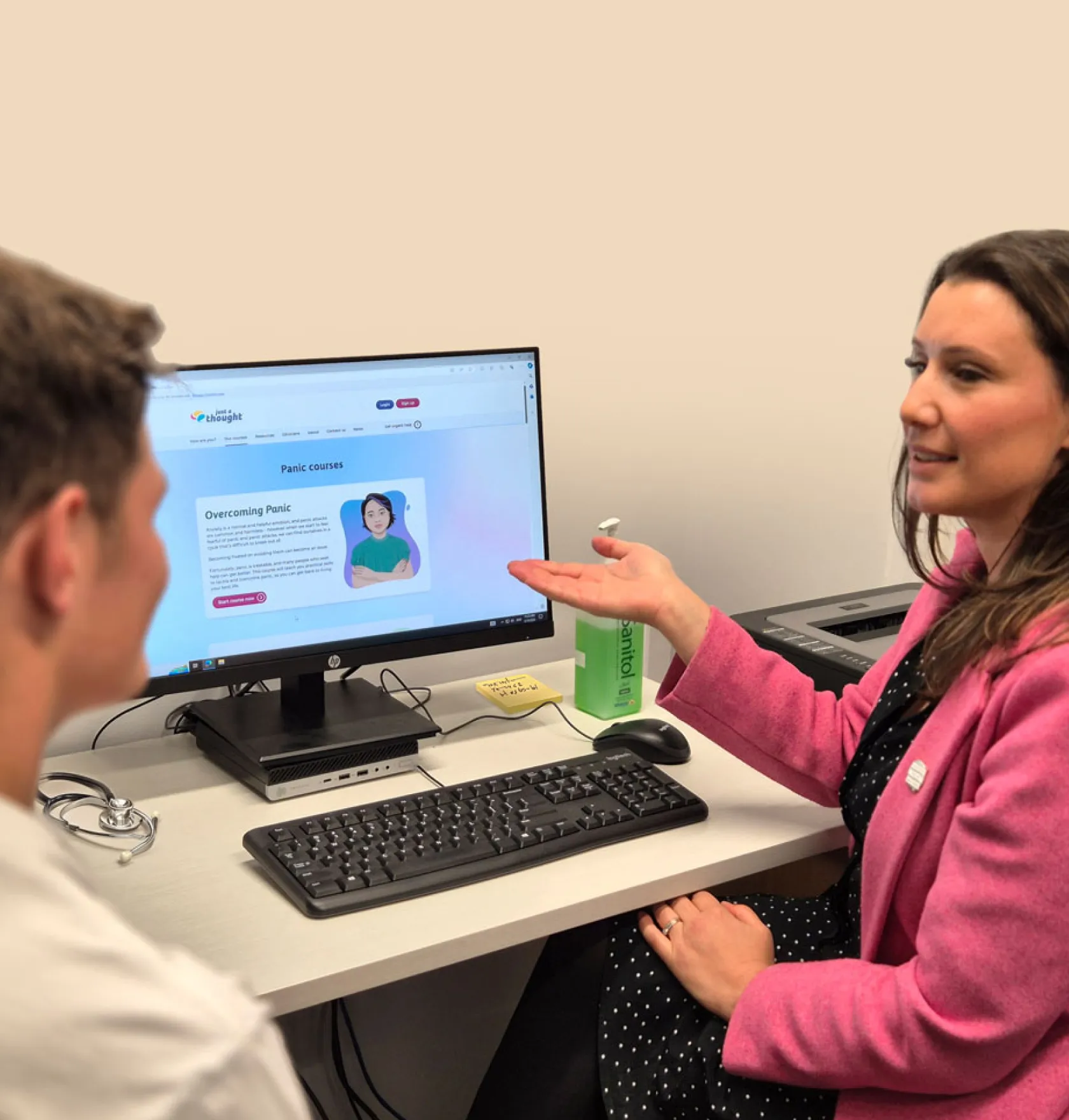
After creating a free account, select and prescribe evidence-based mental health courses for your tāngata whai ora or patients, who get instant access.


Monitor progress
Through your secure dashboard, you can monitor patient progress, view assessment scores, and use real-time insights to personalise your care.
Support and encourage
Our research tells us tāngata whai ora are more likely to complete their course when supported by their healthcare worker.

Get full access.
As a registered healthcare worker, you'll be able to preview all courses and resources. You'll see exactly what your patients will get.
Frequently Asked Questions
Still have questions?
Check out our FAQs below, or reach out to hello@justathought.co.nz - we'd love to hear from you.
Clinical responsibility is only relevant to healthcare workers who prescribe a Just a Thought course to their whai ora or patients.
Clinical responsibility when prescribing a Just a Thought course:
Clinicians who prescribe Just a Thought courses will take clinical responsibility for their patients, exactly as if they were prescribing medication or providing another treatment where monitoring of response is required. Only the 'prescribing healthcare worker' will be able to see the progress of their whai ora or patients registered with Just a Thought. Progress includes lessons completed and psychological assessment scores, it does not include personal information from worksheets or course materials.
If you prescribe a Just a Thought course and maintain clinical responsibility for your patient, you will have access to your patient’s progress report after your patient completes each part of the course.
High distress alerts
You’ll receive an alert if a patient you prescribed a Just a Thought course to scores:
- over 30 on the Kessler Psychological Scale (K10), indicating high to very high levels of distress, or
- over 20 the Patient Health Questionnaire (PHQ-9), indicating severe levels of depressive symptoms, or answers positive to the self-harm question
For confidentiality reasons, the alert email will not include the patient’s name. To see which patient is experiencing higher distress you’ll need to log in to your Just a Thought dashboard where you’ll see a distress alert next to the patient’s name.

The patient will also receive an automated email letting them know their prescribing healthcare worker has been alerted and encouraging the patient to reach out and seek support.
After signing up as a Healthcare Worker, you can prescribe courses easily from your Healthcare Worker Dashboard. The patient receives an email with instructions to start the course, and you can monitor their progress. The patient will also receive an automated email letting them know their prescribing healthcare worker has been alerted and encouraging the patient to reach out and seek support.

Whai ora or patients receive encouraging automated emails and reminders throughout the course. If the course has been prescribed, healthcare workers can provide additional support and monitor progress via their Healthcare Worker Dashboard. The team at Just a Thought provides technical support but does not monitor individuals as they complete their courses or provide personalised clinical advice. Whai ora or patients can request a certificate of completion when they finish their course.
Whai ora or patients who are experiencing mild-to-moderate anxiety or low mood / depression or other mental health challenges are suitable for a Just a Thought course. Your clinical judgment will assist you to identify tāngata whai ora who may benefit from a Just a Thought course. We recommend delaying prescription of courses to anyone that may be acutely unwell, or actively suicidal.
By checking in with tānga whai ora during their engagement with a course, research shows this can make a big difference to applying the new skills in their daily life.
Research shows two simple things make a big difference:
- Encourage them to complete each part of the course and practice the skills in their daily life.
- Check in regularly by phone or in person (either you or a support person). This keeps them engaged and motivated.
These evidence-based steps improve course completion and outcomes.
The more support and encouragement provided, the better a patient will do. Previous studies have shown that even just 30 minutes of email support over the duration of a course (five minutes per lesson):
- whai ora can achieve outcomes comparable to in-person clinical support, and
- around 80% of whai ora complete the course.
Without support, whai ora are significantly less likely to complete their course.
Therefore, reminders and regular encouragement by a supportive clinician will produce the best results.
If you prescribe a Just a Thought course and maintain clinical responsibility for your patient, you will have access to your patient’s progress report after your patient completes each part of the course. These will be available to view on your Just a Thought Healthcare Worker Dashboard after logging in.
The explanations below will assist you in interpreting these reports.
Kessler Psychological Scale (K10)
- 0-19: No to low distress
- 20-30: Moderate
- 31-40: High
- 41-50: Very high
Individuals seen in primary care who score over 20 have significant distress.
K10 should decrease as patients complete the courses.
If scores remain in the severe range (>30) or increases dramatically, we recommend you arrange an immediate review with your patient.
Short Warwick-Edinburgh Mental Wellbeing Scale (SWEMWBS)
This is a measure of mental wellbeing
- 7-17: Very low
- 18-20: Low
- 21-27: Good
- 28-35: Great
Scores should increase as patients complete the course.
Generalised Anxiety Disorder Scale (GAD-7)
This is a measure of worry and physiological symptoms of anxiety.
- 0-5: No to low anxiety
- 6-10: Mild
- 11-15: Moderate
- 16-20: High
Scores should decrease as patients complete the course.
Patient Health Questionnaire (PHQ-9)
This is a measure of depressive symptoms.
- 5-9: Mild
- 10-14: Moderate
- 15-19: Moderately severe
- 20-27: Severe
Scores should decrease as patients complete the course.
World Health Organization-Five Well-Being Index (WHO-5)
This is a measure of self-rated wellbeing.
- 0-7: Poor
- 8-13: Lowered
- 13-25: Good
Scores should increase as patients complete the course.
Insomnia Severity Index (ISI)
This is a measure of insomnia symptoms.
- 0-7: None
- 8-14: Low
- 15-21: Moderate severity
- 22-28: Severe
Scores should decrease as patients complete the course.
Short Health Anxiety Inventory (SHAI)
This is a measure of health anxiety symptoms.
- 0-9: Absent to low
- 10-19: Mild
- 20-29: Moderate
- 30-39: Severe
- 40: Extreme
Scores should decrease as patients complete the course.
Mini-Social Phobia Inventory (Mini-SPIN)
This is a measure of social anxiety symptoms.
- 0-5: Absent to mild
- 6-12: Moderate to severe
Scores should decrease as patients complete the course.
Panic Disorder Severity Scale (PDSS)
This is a measure of panic symptom severity.
- 0-8: Absent to mild
- 9-28: Moderate to severe
Scores should decrease as patients complete the course.
Edinburgh Postnatal Depression Scale (EPDS-5)
This is a measure of postpartum depression symptoms.
- 0-12: Absent to low
- 13-30: Moderate to high
Scores should decrease as patients complete the course.
Dimensional Obsessive-Compulsive Scale (DOCS)
This is a measure of OCD symptoms.
- 0-17: Absent to mild
- 18-20: Moderate
- 21-80: High
Scores should decrease as patients complete the course.
World Health Organization Disability Assessment Schedule 2.0 (WHODAS-II)
This is a measure of physical and mental functioning and wellbeing.
- 0-6: Minimal challenge
- 7-18: Mild challenge
- 19-30: Moderate challenge
- 31-42: Severe challenge
- 43-48: Extreme challenge
Scores should decrease as patients complete the course.
Readiness Ruler
This is a measure of how ready a patient is to make a specific change right now.
- 0-3: Not ready (Pre-contemplation)
- 4-6: Thinking about it (Contemplation)
- 7-10: Ready to take action (Preparation/Action)
Scores should increase as patients complete the course.
Confidence Ruler
This is a measure of how confident the patient feels in their ability to make a change.
- 0-3: Low confidence
- 4-6: Moderate confidence
- 7-10: High confidence
Scores should increase as patients complete the course.
A "healthcare worker" means a person who is, or is deemed to be, registered with an authority as a practitioner of a particular health profession.
This may also include someone who works in a health profession with or under a registered health professional.
For a more detailed definition of a healthcare worker, check the clinician terms of use.
If you have any further questions about what defines a healthcare worker / health practitioner, please contact us on hello@justathought.co.nz
Any healthcare worker / health practitioner (e.g. general practitioner, psychologist, medical specialist, mental health nurse or any other allied health professional) can register to prescribe Just a Thought.
You can recommend a Just a Thought course to your whai ora or patients, and they can complete it independently, while supervised or ‘prescribed’ courses involve healthcare worker oversight, allowing for progress monitoring and support.